
Live vs Recorded Instrumental Songs to Walk Down the Aisle To
- gregwilliams010
- Apr 30
- 16 min read
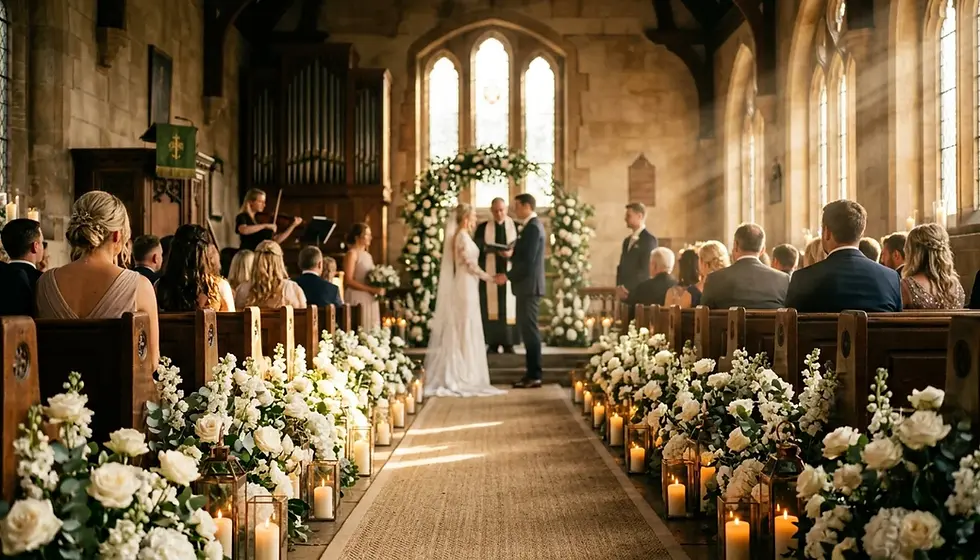
Choosing the right instrumental songs to walk down the aisle to is one of the most emotionally weighted decisions in your entire ceremony plan. But the bigger question most couples overlook is not which song to choose. It is whether that song should be played live by musicians standing at the altar or streamed from a speaker in the corner. Both deliver beauty. Both carry risk. And the difference between them shapes the entire feel of the moment far more than the song title does.
Live instrumental musicians create adaptable, real-time performance that adjusts to your pace, corrects for late entrances, and adds irreplaceable warmth to a ceremony.
Recorded instrumental tracks cost significantly less than live performers, offer access to studio-quality arrangements by artists like Vitamin String Quartet and The Piano Guys, and eliminate the risk of instrument tuning issues at outdoor venues.
Classical pieces such as Pachelbel's Canon in D and Bach's Air on the G String remain the most-requested processional instrumentals, but modern covers by Brooklyn Duo and 2Cellos are gaining ground in 2026.
Live string quartets or acoustic duos typically range from $800 to $2,500 or more for ceremony coverage, while curated recorded playlists carry no per-performance cost beyond a sound system rental.
Venue acoustics matter as much as song choice. Outdoor Hill Country ceremonies in Texas and barn venues near Austin often require amplification for live instruments, which changes the cost calculus.
At Uptown Drive, we advise couples to match their music format to their venue size, budget, and how much flexibility they want during the processional itself.
Why the Live vs. Recorded Decision Matters More Than the Song Itself
The format of your processional music refers to whether a human musician performs the piece in real time at your ceremony or whether a pre-recorded track plays through a sound system. This distinction shapes timing, atmosphere, and emotional resonance in ways that no song title alone can determine. A live cellist performing Craig Armstrong's "Glasgow Love Theme" lands differently in the room than the same track through a Bluetooth speaker, regardless of the arrangement's quality.
First, consider timing flexibility. A live musician watches the doors. When the flower girl pauses, the violinist holds the swell. When the processional runs 30 seconds longer than rehearsed, a skilled performer extends the piece without the congregation noticing. A recorded track cannot do this. If your bridal party walks slower than you practiced, you either arrive to silence or the music cuts mid-phrase.
Second, consider emotional resonance. Live music produces micro-variations in tempo, dynamics, and articulation that recorded tracks, no matter how polished, cannot replicate in the room. The bow on a cello string three feet from your guests creates a physical vibration that a speaker cannot reproduce. This is not a romantic abstraction. It is physics.
Third, and most practically: cost. Live ceremony musicians represent a meaningful line item. Recorded music, managed by your DJ or a dedicated sound operator, can cost a fraction of that. Both approaches work beautifully when executed well. The question is which trade-offs matter most to you.
If you are still exploring your broader ceremony music vision, the ultimate guide to the best songs played at weddings in Texas for 2026 covers reception and first dance music alongside ceremony selections, offering a wider framework for planning your full wedding soundtrack.
What Is a Good Instrumental Song to Walk Down the Aisle To?
A good instrumental song to walk down the aisle to is one that matches three criteria: the tempo suits your natural walking pace, the emotional tone reflects the feeling you want to carry into your vows, and the arrangement holds up across the full length of your processional. Song length matters practically. A piece that peaks and resolves in 90 seconds may leave the final bridesmaid still walking when the music ends.
Classical processionals remain the gold standard for a reason. Pachelbel's Canon in D has a repeating harmonic structure that extends naturally without feeling forced, making it ideal when processional timing is unpredictable. Bach's Air on the G String carries a measured, stately pace that works at almost any walking speed. Debussy's Clair de Lune is romantic but slower, better suited to an intimate ceremony of under 80 guests where a delicate dynamic carries the room.
For modern options, the Brooklyn Duo's cello and piano cover of "All of Me" by John Legend is one of the most-requested contemporary processionals right now. Vitamin String Quartet's arrangements of songs like "Come Away With Me" (Norah Jones) and "Hymn for the Weekend" (Coldplay) offer the accessibility of familiar melodies with the refinement of chamber performance. The Piano Guys' cover of "A Thousand Years" by Christina Perri, performed as a piano and cello duet, has become a near-universal recommendation for the bridal entrance specifically.
For soundtrack and cinematic choices, Craig Armstrong's "Glasgow Love Theme" is a piano solo timed impeccably to a slow bridal walk, and the Vitamin String Quartet's arrangement of the Jurassic Park Theme is a surprisingly moving choice for couples who want something recognizable but unexpected. Lindsey Stirling's original composition "Between Twilight" is worth considering if you want a violin-led instrumental that is not a cover of anything, giving the moment a sense of uniqueness that no streaming playlist can replicate.
What Is the Best Song for a Bride to Walk Down the Aisle?
The best song for a bride to walk down the aisle is one the two of you chose together, but if you want a data-informed starting point, "A Thousand Years" by Christina Perri in its Piano Guys piano-cello arrangement is the most cross-referenced bridal entrance recommendation across every major editorial source in 2026. It builds gradually, which gives the processional a sense of arrival without frontloading the emotional peak.
For a more traditional ceremony, Jesu, Joy of Man's Desiring (often performed by violin ensembles including the Violin Sisters) and Mendelssohn's Wedding March remain the two most requested classical choices. Both have cultural weight and immediate recognizability that signals ceremony formality to every guest in the room.
If you are walking to something less expected, 2Cellos' cover of "Fields of Gold" by Sting delivers what competitors describe as a moving cello duet suited to a dramatic processional entry. Sigur Ros's "Hoppipolla" works in its original form or as a string arrangement for couples who want something cinematic without being drawn from a film score. And if you want genuine surprise, Kronos Quartet's string arrangement of Jimi Hendrix's "Purple Haze" is documented as a recessional choice that produces an audible reaction from guests, though it is admittedly a specific personality fit.
One practical note: the bridal entrance song should be distinct from the bridesmaids' processional piece. Using a separate arrangement for each signals deliberate planning and gives each entrance its own emotional weight. Consider the O'Neill Brothers' piano arrangement of "Hymne" by Vangelis for the family and wedding party processional, then stepping up in emotional intensity for the bridal entrance itself.
For more song ideas mapped to specific ceremony moments, the guide to unforgettable bride entrance wedding songs covers a curated selection with context for each choice.
Live vs. Recorded: A Side-by-Side Comparison for Texas Ceremonies
Live instrumental performance and recorded music for the processional differ across five practical dimensions: timing flexibility, cost, acoustic performance, customization, and emotional impact. Neither format is universally superior. Your venue, budget, and personal priorities determine which fits your ceremony better.
Criteria | Live Instrumental Musicians | Recorded Tracks |
Timing Flexibility | Adapts in real time to pace, pauses, or late starts | Fixed length; requires precise coordination |
Typical Cost Range | $800 to $2,500+ for ceremony only (duo to quartet) | No per-performance cost; sound system required |
Song Customization | Musicians can learn custom arrangements of any song | Limited to existing recordings; no alteration |
Acoustic Performance | Natural resonance indoors; needs amplification outdoors | Consistent through PA system at any venue |
Emotional Impact | Live performance energy; visible human element for guests | Studio-quality sound; familiar artist recordings |
Weather/Environment Risk | Heat, humidity affect tuning; outdoor setups require covers | Digital source unaffected by environment |
Backup Contingency | Requires backup plan if musician cancels | Digital file has no single point of failure |
Best Venue Type | Indoor ballroom, chapel, intimate outdoor space | Any venue with a quality PA system |
At Uptown Drive, we consistently see couples underestimate how venue acoustics change this calculus. A stone chapel in the Texas Hill Country amplifies a live string quartet beautifully. An open-air riverside ceremony near Austin, by contrast, scatters unamplified sound quickly, which means live acoustic musicians either need their own sound reinforcement (adding to cost and setup time) or they get lost under ambient noise. In that outdoor setting, a clean recorded track through a professional PA often sounds better than unamplified live performance.
Indoor venues with high ceilings, particularly historic spaces in San Antonio and Dallas, tend to flatter live strings enormously. The natural reverb fills the room in a way that even high-quality playback struggles to match. This is the scenario where spending on live ceremony musicians pays its largest dividend.
What Are the Best Instrumental Songs Ever for a Wedding Processional?
The best instrumental songs ever for a wedding processional fall into three categories: timeless classical works that have been performed at ceremonies for centuries, modern pop covers arranged for chamber instruments, and original compositions written specifically for emotional moment-making. Each category serves a different couple and a different ceremony style.
Classical Standards Worth Keeping: Pachelbel's Canon in D remains the single most performed processional piece worldwide, and for good reason. Its ascending harmonic sequence creates a sense of arrival that feels almost biologically programmed to suit the moment. Bach's Air on the G String and Mendelssohn's Wedding March are close behind. Debussy's Clair de Lune works best in intimate spaces where its delicate dynamics carry without amplification.
Modern Pop Covers That Hold Up: Vitamin String Quartet's catalog is the most referenced ensemble across competitors for a reason. Their arrangements of "1,2,3,4" by Feist, "Best Day of My Life" by American Authors, and "Can't Stop the Feeling" by Justin Timberlake transform familiar pop songs into something genuinely beautiful. Brooklyn Duo's chemistry-laden cello and piano covers of "Halo" by Beyonce, "Lovely" by Billie Eilish, and "Stay With Me" by Sam Smith are among the most emotionally effective processional options available on streaming platforms today. The Pink Blossom Records "Best Wedding Instrumentals 2026" playlist on Spotify has accumulated over 56,000 saves and functions as a reliable discovery tool for previewing these arrangements before committing to one.
Less Expected but Genuinely Moving: The Fairy Tail Theme arranged by Taylor Davis on violin, the Jurassic Park Theme by Vitamin String Quartet, and "Married Life" from the film Up in a violin and piano arrangement by Paul Hankinson Covers all deliver immediate emotional recognition without feeling cliched. Sigur Ros's "Hoppipolla" in its original form is also worth serious consideration for couples who want something cinematic and atmospheric that most guests will feel rather than immediately name.
For a deeper look at how ceremony entrance music has evolved, the guide to wedding walk-in music with eight perfect songs for 2026 offers a curated perspective on current trends across Texas ceremonies.
What Is a Good Song to Walk Back Down the Aisle To?
A good recessional song is one that releases the emotional tension of the ceremony with joy, energy, or celebration. The recessional is not a second processional. It is a musical exhale. The couple has just made a lifelong commitment, and the music that carries them back up the aisle should reflect that shift from reverence to elation.
The Piano Guys' piano and cello cover of "A Sky Full of Stars" by Coldplay is described specifically as a recessional choice, and it works because it builds to a bright, energetic resolution rather than sustaining the slow emotional weight of a bridal entrance piece. Beethoven's "Ode to Joy" in the Piano Guys' arrangement with two cellos and piano is another strong option: it carries unmistakable triumph without feeling silly or ironic.
For something surprising, Kronos Quartet's string arrangement of Jimi Hendrix's "Purple Haze" is a documented choice that produces an audible reaction from guests, and it is legitimately effective for couples whose ceremony otherwise leans traditional. The unexpected contrast between the formal ceremony and the recessional creates a memorable moment. Brides.com's dedicated list of 90 wedding recessional songs offers additional range if you want to compare options across tempos and genres before deciding.
If you use live musicians for the processional, the recessional becomes an opportunity to shift energy dramatically. Ask your string quartet or acoustic duo to pick up tempo and dynamics on the return walk. The contrast between a slow, reverent entrance and an upbeat exit lands beautifully in the room. If you are using recorded tracks, the same principle applies: choose a recessional arrangement at a noticeably higher energy level than your processional.
How Venue Acoustics and Outdoor Settings Change Everything
Venue acoustics are the single most underaddressed variable in processional music planning, and no competitor currently covers this with any specificity. The difference between a live string quartet sounding transcendent and sounding thin often comes down entirely to the room, not the musicians.
Specifically, hard parallel surfaces (stone walls, wood floors, high ceilings) create natural reverb that makes acoustic instruments bloom. Chapels and historic ballrooms in San Antonio and Austin's older venues excel here. Soft surfaces (heavy drapes, grass, open sky) absorb sound, which means unamplified live instruments lose energy quickly and detail disappears before reaching the back rows.
For outdoor Texas ceremonies, particularly Hill Country venues with ambient wind and open landscape, this matters enormously. A violinist or cellist playing unamplified 20 feet from the nearest guest is performing primarily for the front three rows. Everyone behind them hears fragments. A professional PA system running a high-quality recorded track, operated by an experienced sound engineer, fills the entire space evenly. In this scenario, the recorded option is not a compromise. It is technically the better choice for guest experience.
Live musicians at outdoor venues need their own sound reinforcement to perform at the level couples expect. This means either hiring musicians who bring their own amplification (ask explicitly before booking) or coordinating with your venue's AV vendor to mic the performers. Factor that additional complexity and cost into your comparison. It often adds $200 to $400 to the total for a single acoustic duo, and it requires a proper soundcheck, which takes time on your wedding day.
Indoor venues with challenging acoustics do exist too. Ballrooms with low drop ceilings and heavy carpet can muffle live strings, making them sound small. In these spaces, a well-EQ'd recorded track through a quality speaker system can actually project more warmth and presence than the real thing. This is not a knock on live musicians. It is a straightforward acoustic reality that couples deserve to know before they spend their ceremony music budget.

How to Plan the Timing and Cueing of Your Processional Music
Processional music timing is one of the most common ceremony coordination failures, and it is almost entirely preventable with a clear plan. Whether you use live musicians or recorded tracks, the person responsible for cueing the music needs a specific signal, not a general instruction to "start when everyone is ready."
Here is a practical framework, based on what we see work consistently across Texas ceremonies:
Establish a designated music cue person. This is either your DJ, your sound operator, your band's musical director, or a specific trusted person with a clear sight line to the ceremony entrance. Vague shared responsibility produces awkward gaps.
Rehearse with actual timing. Walk the full processional distance at your actual pace during the rehearsal. Time it with a phone. Now you know whether your chosen piece is long enough or whether you need to plan a second pass or a fade-out point.
Map each entrance to a section of the music. If you are using one piece for the full processional, designate which moment each group enters. Guests and family first, then wedding party, then the bride. For recorded tracks, note the timestamp where each group should start walking. For live musicians, brief them on this sequence explicitly.
Build in a buffer for late starts. Ceremonies run late. A live musician can extend and repeat. A recorded track cannot. If you are using recorded music, choose a piece at least 60 seconds longer than your rehearsed processional time, and brief your cue person on where to fade if the processional ends early.
Confirm the transition to the ceremony opening. Who signals the music to stop after the bride reaches the altar? This handoff needs to be clear, whether it is a nod to the officiant, a hand signal to the DJ, or a predetermined musical resolution point.
Live musicians have a structural advantage here because they can read the room and adjust. But they need a briefing, not just a song list. A string quartet that has not been told which family member walks when, or whether the bridesmaids walk solo or in pairs, cannot time their transitions well. Give them a written order of processional. It makes a measurable difference.
For couples exploring non-traditional ceremony music structures, these eight wedding music alternatives for an unforgettable day offer creative approaches that go beyond the standard processional format.
Who Should Choose Live Instruments, and Who Should Choose Recorded Tracks?
Live instrumental performance is the right choice when your venue has favorable acoustics, your budget accommodates professional ceremony musicians, and you want the ability to adapt in real time to whatever the processional brings. A live string quartet or acoustic duo at an indoor Texas venue with stone walls and high ceilings creates a ceremony experience that no recording can replicate. If you are marrying at a historic venue in San Antonio, an Austin chapel, or a luxury ballroom in Houston with natural reverb and intimate scale, live musicians reward the investment fully.
Recorded tracks make the most sense when your ceremony is outdoors, your venue requires substantial amplification regardless, your budget is better allocated elsewhere (toward your reception band, for example), or you have a specific song in mind whose only great arrangement exists as a studio recording. Vitamin String Quartet, Brooklyn Duo, and The Piano Guys produce recorded arrangements that are genuinely excellent. Using their recordings is not settling. It is making the right tool choice for the moment.
A hybrid approach works well at many Texas weddings. A live soloist (a single violinist or acoustic guitarist) handles the prelude and bridesmaids' processional while the main bridal entrance uses a specific recorded arrangement chosen for its exact emotional quality. This reduces cost compared to hiring a full quartet while preserving the warmth of live performance for the first 20 minutes of the ceremony.
For those considering live wedding bands for the reception rather than the ceremony, the investment calculus changes. A full live band for the reception is a different decision entirely, and for many couples, it represents the higher-value allocation of their music budget.
Frequently Asked Questions
How much does it cost to hire live musicians for a wedding processional?
Live ceremony musicians typically range from $800 to $2,500 or more depending on ensemble size, performance duration, and your market. A solo violinist or acoustic guitarist generally costs less than a string duo, and a full string quartet commands the highest rate. Austin, Dallas, and Houston markets carry professional rates that reflect their competitive demand. Always confirm whether travel fees, setup time, and amplification equipment are included in the quoted price, as outdoor ceremonies often require additional sound reinforcement.
Can live musicians learn a specific song I want for my processional?
Yes. One of the clearest advantages of hiring live musicians is that professional performers can learn custom arrangements of virtually any song. If you have a meaningful song that does not exist as a published instrumental arrangement, a skilled violinist, cellist, or acoustic guitarist can create one from the original recording or lead sheet. Provide the song at least four to six weeks before the ceremony, and confirm with the musician that custom arrangement learning is included in their fee or quoted separately.
What instrumental song do most brides choose for the aisle walk in 2026?
The Piano Guys' piano and cello arrangement of "A Thousand Years" by Christina Perri remains the most cross-referenced bridal entrance recommendation across major editorial sources in 2026. Classical alternatives like Pachelbel's Canon in D and Bach's Air on the G String remain consistently popular. Brooklyn Duo's covers of "All of Me" and "Halo" lead the modern pop cover category. Ultimately, the most popular choice is less important than choosing a piece whose tempo, emotional tone, and length suit your specific processional.
Does outdoor or indoor venue type affect whether I should use live or recorded music?
Yes, significantly. Indoor venues with hard surfaces and natural reverb (stone chapels, historic ballrooms) flatter live acoustic instruments and make them carry the room naturally. Outdoor ceremonies, particularly in open settings like Texas Hill Country or riverside locations, scatter unamplified sound quickly. Live musicians at outdoor venues typically require their own amplification to be heard by all guests. In those settings, a high-quality recorded track through a professional PA system often delivers more consistent sound quality than unamplified live performance at the same price point.
What is a good recessional song after the ceremony?
A strong recessional instrumental should shift energy upward from the reverent tone of the processional. The Piano Guys' cover of "A Sky Full of Stars" by Coldplay is a recommended recessional choice specifically for its bright, celebratory resolution. Beethoven's Ode to Joy carries unmistakable triumph and works at almost any ceremony style. For something unexpected, Kronos Quartet's string arrangement of "Purple Haze" by Jimi Hendrix is a documented recessional choice that produces a memorable guest reaction. The key is choosing something noticeably more energetic than your processional piece.
How do I cue processional music precisely during the ceremony?
Precise cueing requires a designated person with a clear sight line to the entrance doors, a specific agreed-upon signal (not a vague verbal cue), and timing confirmed during rehearsal. Walk the full processional distance and time it during rehearsal. For recorded tracks, choose a piece at least 60 seconds longer than your rehearsed processional and brief your sound operator on a fade point if needed. For live musicians, provide a written order of entrances so they know exactly which group walks when and can adjust in real time.
Can I use both live musicians and recorded tracks in the same ceremony?
Absolutely, and for many Texas weddings this hybrid approach offers the best of both formats. A common structure uses a live soloist for the prelude and bridesmaids' processional, then transitions to a specific recorded arrangement for the bridal entrance. This preserves the warmth of live performance during the ceremony's opening while allowing you to use a particular studio recording that has the exact sound you want for the most emotionally significant moment. Coordinate the transition carefully with your sound operator so the handoff between live and recorded audio is seamless.
Making the Final Call on Your Processional Music
The right format for your instrumental songs to walk down the aisle to comes down to four honest questions: What does your venue sound like? What is your ceremony music budget? How much timing flexibility do you need? And is there a specific recording that already has the exact sound you want?
Live musicians win on adaptability, emotional immediacy, and the visible human element that guests feel in the room. Recorded tracks win on cost, consistency, and access to studio-quality arrangements from artists like Vitamin String Quartet, Brooklyn Duo, and The Piano Guys that would be difficult to recreate at any price point. Neither is a fallback. Both are legitimate, professional choices when planned correctly.
In 2026, the most satisfied couples are those who make this decision deliberately rather than defaulting to one format out of habit. Give your ceremony music the same intentional planning you give your florals, your catering, and your photographer. Brief whoever is managing your sound, confirm your timing during rehearsal, and choose a song whose emotional arc matches how you want that walk to feel.
For Texas couples exploring live professional musicians for both ceremony and reception, the team at wedding musicians in Austin can walk you through options for both formats across the Austin, Dallas, Houston, and San Antonio markets. The right conversation starts with your venue and your vision, not a price quote.
If you want professional live musicians who understand Texas venues, have performed on international stages, and bring over 250 five-star reviews to every event, contact Uptown Drive to discuss ceremony and reception music for your wedding. The conversation is the first step toward a processional that sounds exactly the way you imagined it.


Comments